

How to Package Scented Candles for Shipping Without Breakage
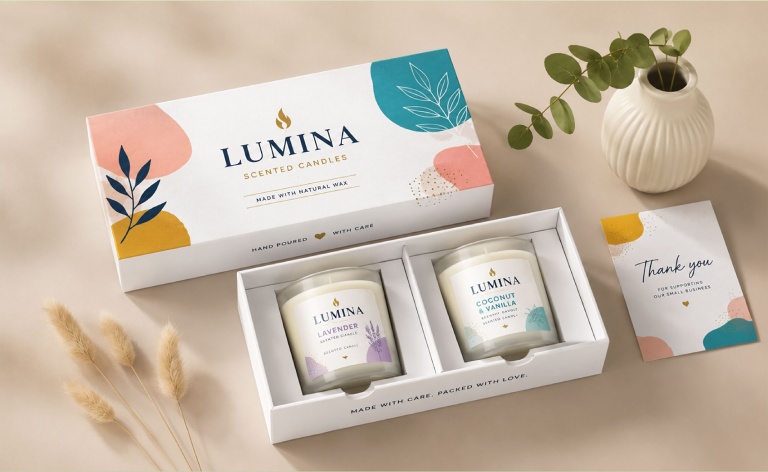
To ship scented candles without breakage, lock each candle into a die-cut insert or fitted tray so the candle jar can't move, then pack that inside a sturdy double-wall corrugated shipping box. A snug box insert does what loose fill can't: it holds each candle in a fixed position through every drop, stack, and knock in transit. Run a drop test before you commit to a method. This guide breaks down exactly how and why candles break in the first place, and the mistakes that cause most damage claims.
Why Do Candles Break in Transit?
Candles are one of the harder products to ship well because they combine three risk factors in a single item:
- They're heavy. A filled glass jar carries far more mass than its size suggests, so it hits harder when a parcel is dropped.
- They're rigid and brittle. Glass and ceramic containers crack on impact and chip at the rim; even tins dent and pop their lids.
- They move. Any gap inside the box lets the candle shift, and a heavy object rattling against cardboard or against a second candle is how most breakage happens.
On top of that, parcels are routinely dropped, stacked under heavier boxes, and, for scented candles specifically, exposed to heat. Left in a hot delivery vehicle, soft waxes can soften or sweat, ruining the surface and the scent even if the glass survives. Your packaging has to manage all four: impact, compression, movement, and temperature.
What You Need: The Two-Layer Packaging System for Shipping Candles
Reliable candle shipping almost always uses two layers: a protective insert that immobilizes the candle and a shipping box that absorbs transit abuse. Skipping either is where damage claims come from.
The Packaging Insert: Your Primary Defense
The custom-fitted insert prevents breakage by securing each candle in a fixed position during transit. Loose padding allows the container to shift inside the box until something cracks; a fitted insert holds it in a fixed position no matter how the parcel is handled. Your options, strongest first:
- Die-cut corrugated inserts — cut to fit your exact candle jar or container, with a cell per candle. The most cost-effective way to lock candles in place and keep multiples from touching.
- Molded pulp inserts — securely support the base and sides of the container; protective and fully recyclable. Ideal for premium and eco-focused brands.
- Rigid dividers — separate candles in multi-unit orders and gift sets so glass never meets glass.
- A snug inner box or wrap around the candle jar to guard the rim and finish against scuffs and chips.
A candle held firmly by a well-fitted insert has already survived most of what shipping will throw at it.
The Shipping Box: Your Secondary Defense
- A double-wall corrugated shipping box for anything heavy or multi-unit. Single-wall is fine only for a single lightweight candle over short distances.
- Minimal cushioning, only to close any remaining gaps. With a fitted insert doing the work, you need far less loose fill, not more. The test is simple: when you gently shake the sealed box, nothing should move.
Step-by-step: How to Pack a Candle for Shipping
- Cap or secure the lid. Make sure lids are on and, for tins, taped if they can pop.
- Wrap the candle jar or container. One layer of tissue or honeycomb kraft wrap around the glass, covering the rim.
- Seat each candle in its insert. The candle should sit snugly in its cell with no side-to-side play. For multiples, every candle gets its own cell so they never touch.
- Place the insert in the shipping box. Center it so there's even clearance on all sides, with a layer of cushioning under the base so the base takes the hardest hits.
- Close any remaining gaps. With a fitted insert, this is minimal, just enough that nothing can move.
- Shake test. Seal loosely and give it a gentle shake. If anything shifts, adjust the insert or add additional cushioning until the package feels secure.
- Tape and label. Tape all seams using the H-taping method and add a Fragile/This Way Up label. (Labels don't guarantee careful handling, but they help.)
Special Cases:
Multi-candle Orders and Gift Sets: Never let candles touch. Use a die-cut insert with a cell per candle, or rigid dividers, and treat the whole tray as a single primary unit inside a double-wall box.
Subscription Boxes: These ship at volume and need a repeatable, fast-to-pack system. A branded mailer box with a fitted insert protects the candle and delivers the unboxing moment subscribers expect in one step.
Different Candle Containers: Glass jars are the most impact-sensitive; ceramic chips at the edges; tins dent and pop lids (tape them); concrete or cement containers are heavy and prone to cracking, so they need extra base cushioning. Match your insert depth to the vessel.
Wax Melts: Clamshells and pouches are lighter and less fragile, but wax melts are heat-sensitive.
Protect Candles from Heat During Shipping
Scented candles are as much a temperature problem as an impact problem. Many soy and paraffin waxes soften well below the temperatures a parcel can reach inside a delivery vehicle in summer, which causes surface sweating, tunneling, and muted scent even when the glass is intact.
To reduce heat damage: avoid shipping over long weekends and heatwaves, when parcels sit in transit longer; consider insulated liners for hot-climate destinations; and set customer expectations at checkout for summer orders.
The five most common candle-packing mistakes
- Relying on loose fill instead of a fitted insert: Padding cushions impacts, but a properly fitted insert provides the structural support needed to keep candles secure during transit.
- Inserts that don't fit the candle jar: A cell that's too loose defeats the purpose. Size inserts to your exact jars.
- Single-wall boxes for heavy or multiple candles: Outer cartons that lack sufficient strength may become crushed or punctured during transit.
- Letting vessels touch: Glass-on-glass contact is a top cause of cracks; give every candle its own cell.
- Ignoring heat: Perfect impact protection won't save a candle that melted in the van.
Test Before You Scale
Before you standardize on a packaging method, test it. A simple drop test, dropping a packed parcel from approximately waist height onto a hard surface across its corners, edges, and faces, can quickly reveal weak points. Brands shipping at volume often follow standardized testing methods such as ISTA (International Safe Transit Association) testing, which simulates real-world transportation conditions, including drops, vibration, compression, and other handling stresses. It's far cheaper to break a few test candles than to absorb a wave of damage claims and replacements.
If you're developing custom candle packaging, it's recommended to order and approve hard-copy samples before full production. This allows you to verify structural integrity, insert fit, load-bearing capacity, and material suitability under your actual shipping conditions.
Get Candle Packaging That Ships Intact
At Printingblue, we make custom candle boxes, fitted inserts, and shipping-ready mailer boxes designed around your exact vessels with no minimum order, so you can test before you commit. Send us your jar dimensions and order volume, and we'll recommend a packaging solution tailored to your jar dimensions, shipping method, and brand requirements.
Frequently Asked Questions
What's the best box for shipping candles?
A double-walled corrugated shipping box sized to fit the candle, with a fitted insert or divider inside to prevent movement. Single-wall boxes are only suitable for a single lightweight candle over short distances.
How do I stop candles breaking in the mail?
Immobilize the candle in a fitted die-cut insert so it can't move, wrap the candle jar, and pack the insert inside a double-wall box. The goal is to prevent the candle from shifting inside the shipping box.
Do I need bubble wrap to ship candles?
Not necessarily. Bubble wrap works, but molded pulp or corrugated inserts protect the candle better because they immobilize it rather than just cushion it, and they're more sustainable. The key is to secure the candle in place rather than rely solely on extra cushioning.
How do I ship multiple candles in one box?
Use inserts or dividers with a separate cell for each candle so the candle containers never touch, then pack the whole tray as one unit inside a double-wall box with void fill around it.
How do I protect candles from melting during shipping?
Avoid shipping ahead of long transit windows in hot weather, consider insulated liners for hot climates, and set delivery expectations at checkout for summer orders. Check your wax's softening point so you know your risk temperature.
Can candle packaging be both protective and eco-friendly?
Yes. Molded pulp inserts, corrugated dividers, paper void fill, and recyclable kraft mailers protect candles effectively while remaining recyclable.
Professional Design & Printing Services
Printingblue offers customized commercial printing solutions to meet your business needs. Our expert team delivers top-notch design and printing services that exceed expectations. Contact us today for a free consultation.